Used AI to turn hours of expert interpretation into a five-minute briefing
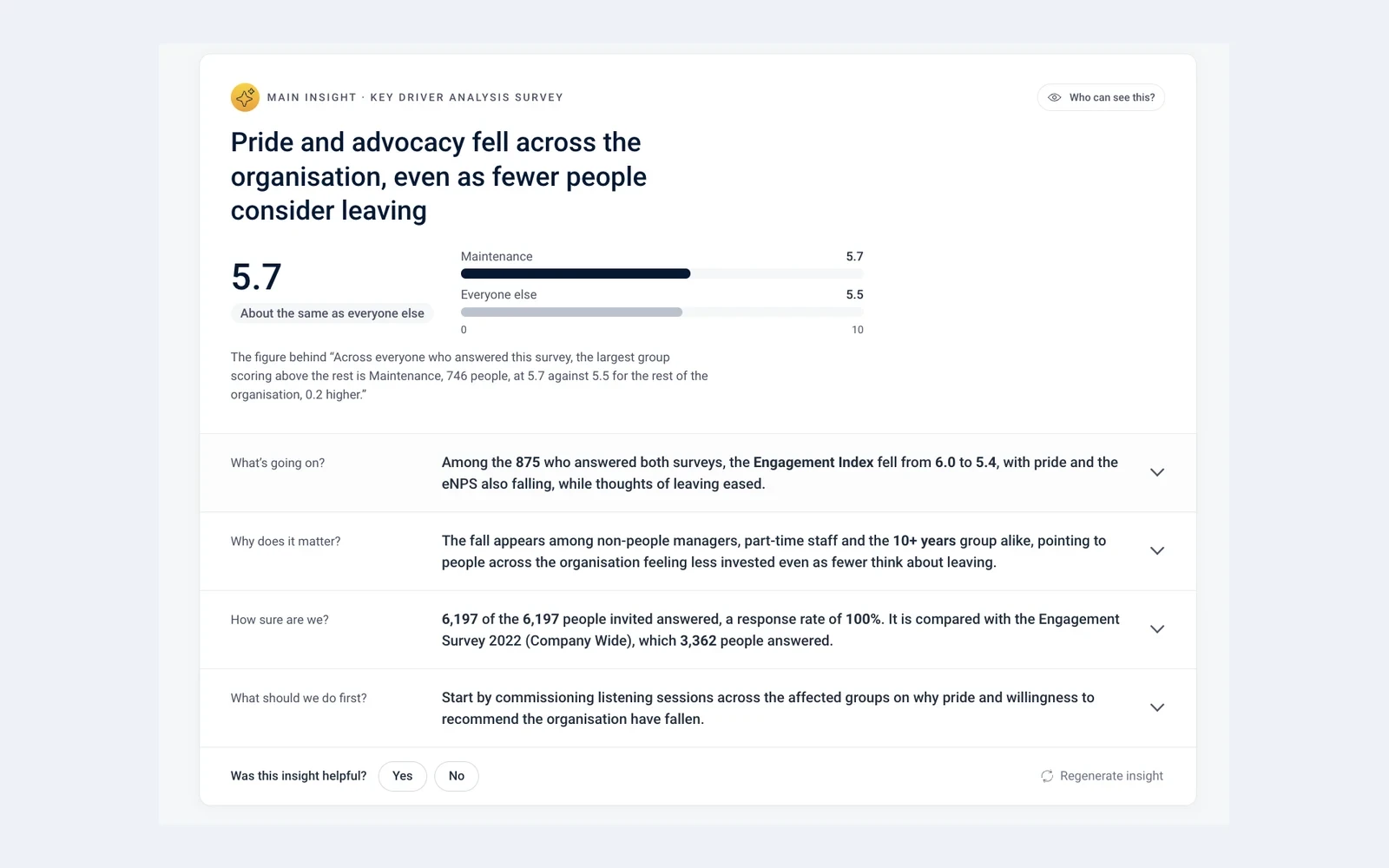
Move four of four. A new AI product that tells an HR Director or a line manager what matters in their results and what to do next. I took it to leadership as an explicit bet.
- Company
- Hive HR
- Year
- 2026
- Role
- Product Manager (solo)
- Team
- Data team, in-house experts, engineering, leadership
- AI in product
- Product strategy
- Quality and evaluation
At a glance
- The problem
- Customers had powerful tools but didn't know what their results meant. Only our experts could explain them, and only for the few customers they had time for.
- My role
- Product owner. I made the case to leadership as a bet, defined what good looked like, and led quality testing.
- The result
- Expert-level interpretation in about five minutes. Early adopters called it game-changing.
The problem
Most of our customers were public sector bodies, universities and charities. Their HR teams and managers are busy, and they aren’t analysts. They’d look at a dashboard and leave without knowing what to do.
Our experts could answer the question every user had (“what do I need to know, and what should I do?”), but only for the customers they had time for. Their insight reached HR Directors and almost never line managers.
What I did
Named it as a bet. I told leadership what we didn’t know: would it be accurate enough, did customers really want it, could a bigger competitor beat us to it, and what wouldn’t we build instead? Saying this up front made the later conversations about results honest and easy.
Kept the AI away from the maths. The product runs the statistics first. AI then picks what’s worth saying and writes it up for the reader’s role. It never calculates anything, and every claim links to its evidence.
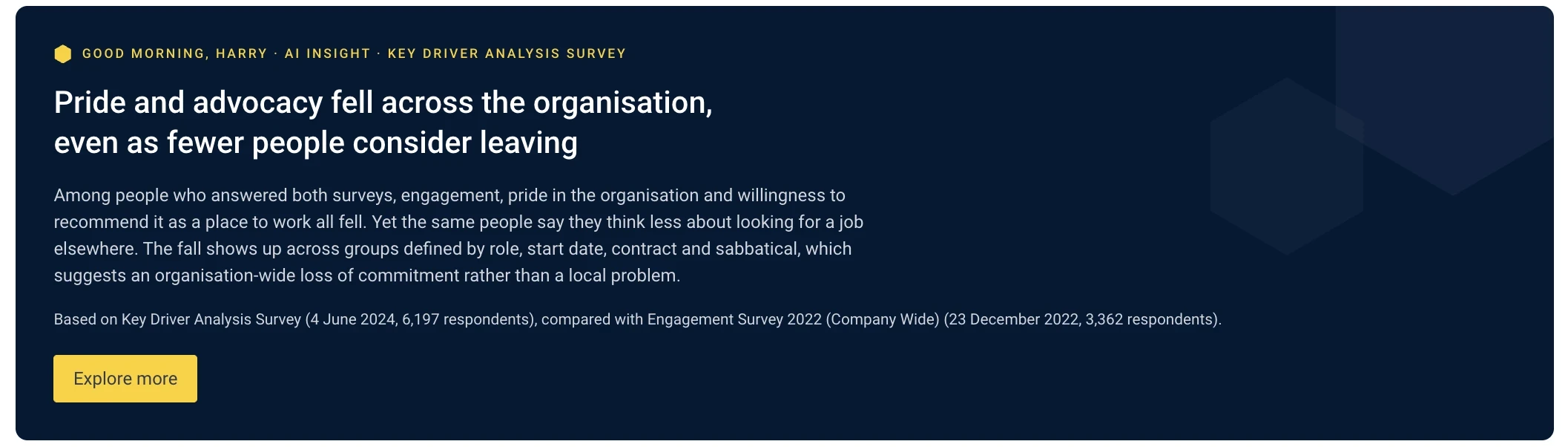
Defined good before building. You can’t judge AI output by eye. So I wrote a scoring rubric first. The first full run scored 12 out of 15, which showed us exactly where we were losing points. We added rules that block any claim the data can’t support, because an overclaiming insight is worse than none.
When outputs looked wrong, the instinct was to blame the AI. Almost every time, the real cause was in our own data or prompts, which we could fix.
The result
- for interpretation that took experts hours
- ~5 minutes
- on the quality rubric, first full run
- 12 / 15
- for every customer, not just a few
- Every survey
Customers asked how we’d found insights they couldn’t see themselves, which showed it was more than a summary. An early adopter group called it “game-changing”.
This was tested with real data and a small early group, not a full release. Hive was acquired before general release, but the bet proved out: it was accurate, and people wanted it.